What is Yuneta?
Yuneta is a function-based development framework that implements an independent class system, abstracted from the programming language. Using functions, classes are created with a core and interface composed of three primary elements: attributes, commands, and messages.
Yuneta’s architecture, centered around gclass, gobj, and yuno, allows developers to create powerful, event-driven, and scalable applications tailored to complex systems.
Core Features
1. Class System
Yuneta’s class system operates independently of language-specific class definitions, ensuring compatibility across different programming environments.
Classes (
gclass) define the structure, behavior, and interaction model of reusable components.
2. Interaction Model of GClasses and Gobjs
The interaction or interface of a gclass or gobj is based primarily on the attributes, commands, and messages defined by the gclass:
Attributes:
Represent the configuration and runtime behavior of objects.
Can be modified dynamically to change the behavior of a gobj during execution.
Commands:
Provide direct, high-level interaction.
Executed independently of the current state of the gobj’s FSM.
Can include parameters for more complex operations.
Messages:
Define how a gobj communicates with others. These are:
Input Messages: Trigger actions or state transitions.
Output Messages: Publish information to other components.
Messages are structured as key-value pairs, where:
Event Name: Identifies the purpose of the message.
KW: A dictionary or object containing the payload.
Key Features of a Gclass
No Traditional Inheritance:
Gclasses do not support inheritance in the traditional object-oriented sense.
Instead, gclasses instantiate objects into a hierarchical tree of gobjs within a binary, called a yuno.
The root object of this tree is referred to as
__yuno__or__root__.
Bottom Gobj Mechanism:
Gclasses implement a specific kind of inheritance through the
bottom gobjmechanism:A gobj can designate a child object as its
bottom.Certain elements, such as
attributes, are inherited from thebottom gobj.
Attribute Lookup:
If a gobj does not define an attribute, it attempts to retrieve the attribute from its
bottom gobj.This process continues up the
bottomchain until a gobj with the attribute is found.
Event-Driven Design:
Gclasses define the events their gobjs can handle and emit.
Events are used for communication and triggering state transitions.
FSM-Based Behavior:
Each gclass defines a finite state machine (FSM) that governs the behavior of its gobjs.
Interface Through Attributes, Commands, and Messages:
Gclasses define attributes for configuration, commands for direct interaction, and messages for communication.
Applications of Yuneta
Yuneta is suited for:
IoT: Managing interconnected devices and sensors.
Networking: Building scalable and modular communication systems.
Monitoring: Real-time data collection and analysis.
Complex Event Processing (CEP): Handling asynchronous and distributed events.
What is a gclass?
A gclass (Generic Class) is the template or blueprint for creating gobjs. It defines the structure, behavior, and lifecycle of gobjs. Unlike traditional classes in languages like C, Python, or JavaScript, a gclass is implemented manually using the gclass_create() function, as Yuneta is a function-based development framework.
A gclass provides a complete definition of the structure, behavior, and lifecycle of gobjs. By combining attributes, commands, events, states, and lifecycle methods, it establishes a powerful and flexible framework for developing event-driven, modular systems.
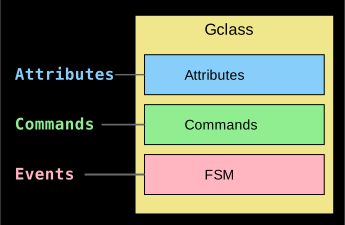
Key Features of a Gclass:
Independent Implementation:
A gclass is not tied to any specific language’s class structure and is manually defined for consistency across environments.
Components of a Gclass:
gclass_name: A unique identifier for the gclass. It must be distinct across all gclasses in the system.event_types: A list of events supported by the gclass. Each event is defined with a name and associated flags. Events, along with commands and attributes, form the primary interface of a gobj. Events define how a gobj interacts with other gobjs and responds to external stimuli.states: A simple finite state machine (FSM) defining:States of the gobj.
Events supported in each state.
State transitions triggered by specific events.
gmt: Global Methods Table, a table of class methods executed by Yuneta’s framework during specific lifecycle events.lmt: Local Methods Table, A table of private methods that can be explicitly invoked by users usinggobj_local_method(). Should only be used when necessary. The natural interface for interacting with gobjs is through events, commands, and attributes.attrs_table: Attribute Table, defines the attributes of the gclass. See the Attributes section. Attributes form a crucial part of the gobj’s interface. They configure the gobj and can dynamically modify its behavior at runtime. Changes to attributes can trigger monitoring or additional actions.priv_size: Specifies the size of private data for the gobj. A memory buffer of this size is allocated for each gobj instance to store its private data (in C).authz_table: Authorization Table, defines access restrictions for specific actions or commands based on user permissions. Enhances security by controlling access to sensitive operations.command_table: Defines commands supported by the gclass. Commands can include parameters and operate independently of the FSM. Commands are parsed using an internal parser, which can be replaced ingobj_start_up()with a custom parser. Commands are a key part of the gobj’s interface, allowing external systems or users to interact with the gobj directly.s_user_trace_level: Defines trace levels for the gclass. These trace levels can be dynamically activated during runtime to log the activity and behavior of gobjs. Facilitates debugging and monitoring of gobj operations.gclass_flag: A modifier for the gclass. Its behavior is defined by thegclass_flag_ttype. May specify flags that alter class-level behavior, such as enabling or disabling specific features.
What is a gobj?
A gobj (Generic Object) is an instance of a gclass (Generic Class) within the Yuneta framework. It is a modular, reusable, and event-driven component that encapsulates data, behavior, and state.
Key Features of a gobj:
Event-Driven Design:
Gobjs interact through external and internal events to trigger actions or state transitions.
They can publish and subscribe to events based on authorization rules.
Hierarchical Structure:
Organized in a parent-child hierarchy where a gobj has one parent and can manage multiple children.
Finite State Machine (FSM):
Each gobj is governed by an FSM that defines its states, events, and state-specific actions.
Modularity and Autonomy:
Gobjs are independent units designed for reusability and scalability.
What is a yuno?
What is a Yuno?
Once a system of gclasses is created, we can build a yuno, which is a single-threaded, asynchronous binary composed of a hierarchical tree of gobjs.
Key Characteristics of a Yuno:
Monolithic Binary:
A yuno encapsulates all functionality within a single binary, simplifying deployment and management.
Asynchronous Execution:
Operates in a non-blocking, event-driven manner to efficiently manage tasks.
Hierarchical Structure:
Built as a tree of gobjs, where:
Each gobj is a node in the hierarchy.
Parent gobjs manage their children, enabling structured interaction and modular design.
Root Object:
The root of the gobj tree is referred to as the
__yuno__or__root__.
Scalability and Modularity:
A yuno can be expanded by adding new gclasses and combining them hierarchically.