This page describes the vocabulary Yuneta uses to model reality: realms, entities, relationships, messages, and the CRUDLU operations on them. It is the concrete counterpart to the Design Principles (why the framework is built this way) and to the Inspiration page (where the words are from).
In Yuneta we seek models (patterns) that allow us to represent and visualize all kinds of realities.
Realms
Yuneta systems are organized into realms.
Each realm has three properties:
| Property | Description |
|---|---|
| Role | Class of the realm |
| Name | Instance of the realm |
| Owner | Owner of the realm |
Realm Terms
The Role defines the class of the realm.
The Name is an instance of that class.
Each realm instance has an Owner who controls it.
The frontend URL defines which realm the user wants to enter. The owner of a realm can add other users and define their authorization levels.
Entity/Relationship Model
We describe reality by classifying it into Entities and the Relationships between them.
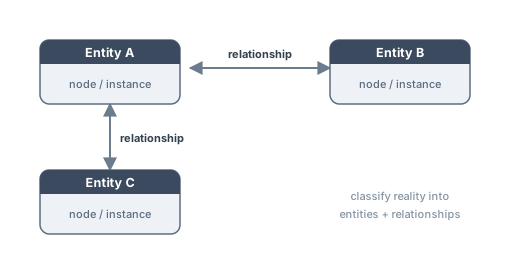
Reality is classified into entities and the relationships between them.
Entities
We describe entities using the pair model:
| Model | Also known as |
|---|---|
| Role / Instance | Class / Object |
| Table / Record | |
| Group / Element |
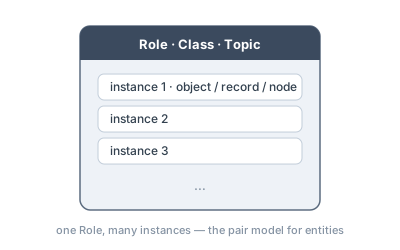
An entity is a Role (class / topic) and its many instances (objects / records / nodes).
Relationships
We describe relationships also using pair models:
Parent / Child — The parent (or a factory) creates and connects to the child.
Service / Client — The client knows and connects to the service.
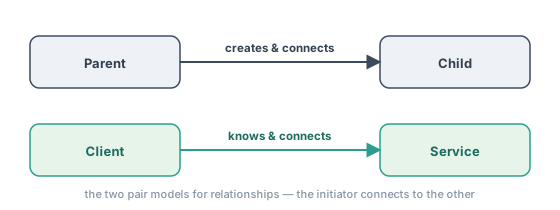
The two pair models for relationships: the parent creates and connects to the child; the client knows and connects to the service.
Message Transport
Entities exchange messages through their relationships (links).
Behavior patterns:
Parent sends events/commands down to children.
Children send events/responses up to parents.
Services publish events to subscribed clients.
Clients send requests to services.
Message Content
The data model used in message content — both internally and externally, for persistence and transport — is key/value.
    ┌──────────┬──────────┐
    │   Key    │  Value   │
    ├──────────┼──────────┤
    │ name     │ "Alice"  │
    │ age      │ 30       │
    │ enabled  │ true     │
    └──────────┴──────────┘
Yuneta can also add the time-series model to transported messages:
    ┌──────────┬──────────┬─────────────────────┐
    │   Key    │  Value   │     Timestamp        │
    ├──────────┼──────────┼─────────────────────┤
    │ temp     │ 22.5     │ 2024-01-15 10:00:00 │
    │ temp     │ 23.1     │ 2024-01-15 10:01:00 │
    │ temp     │ 22.8     │ 2024-01-15 10:02:00 │
    └──────────┴──────────┴─────────────────────┘
Encoding and Persistence
All models are represented in JSON, both in memory and on disk, using:
Hierarchical and Graph databases
Key/Value storage
Time-Series storage
Example topologies:
    Tree (hierarchical):          Graph:

         A                      A ─── B
        / \                     │ \   │
       B   C                    │  \  │
      / \                       C ── D
     D   E


    Key/Value:                  Time-Series:

    ┌─────┬───────┐            ──●──●──●──●──●──► t
    │ k1  │ v1    │              v1  v2  v3  v4
    │ k2  │ v2    │
└─────┴───────┘CRUDLU
Most systems describe entities with the classic CRUD operations:
Create
Read
Update
Delete
Yuneta adds two more because the TreeDB graph store makes relationships first-class citizens, not foreign keys managed by convention:
Link — attach an existing child to an existing parent via a declared hook. The operation is persisted by writing the child’s
fkeyfield (see the Timeranger2 Guide).Unlink — the inverse: clear the child’s
fkey, persist the change.
CRUDLU = Create, Read, Update, Delete, Link, Unlink. Every TreeDB API call is one of these six shapes.
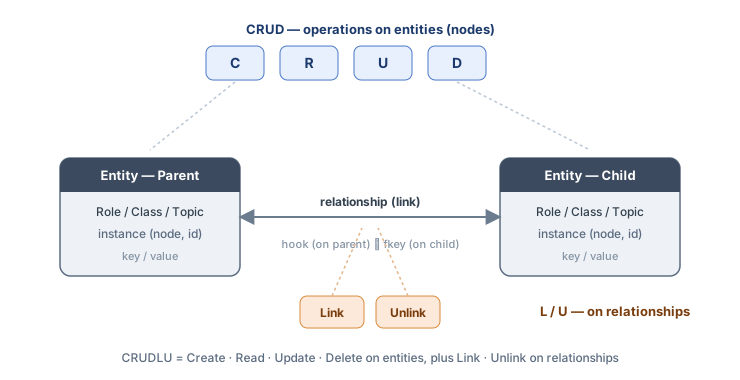
CRUD acts on entities (the nodes); Link / Unlink act on the
relationships between them. A relationship is a hook on the parent
paired with an fkey on the child — see
The Typed-Graph Model.
Where to go next
The Typed-Graph Model — the conceptual frame these entities and relationships fit into: one typed graph spanning both data and behavior.
Architecture — how these entities and relationships become a live structure of services and roles above the compiled gobj tree.
Design Principles — the engineering decisions these concepts sit on (in particular, decision 7 on append-only persistence and decision 8 on the control plane).
Basic Concepts — the same concepts from the implementation side.
Timeranger2 Guide — how CRUDLU works on disk and in memory.