This page answers the question “how do you assemble a Yuneta system above one gobj?”. Design Principles gives the reason for each separate decision. The Typed-Graph Model gives the model that holds the decisions together. This page describes the result: three layers, one message mechanism, and one word — role — that keeps the same meaning in all three.
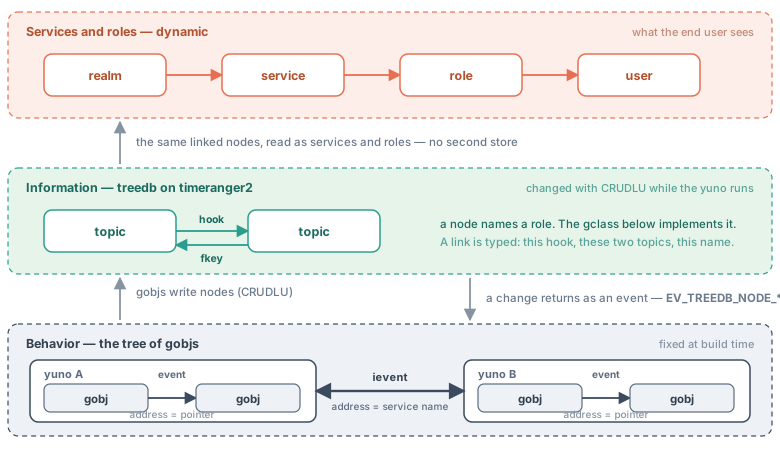
Three layers, and one message mechanism through all of them. The behavior layer is compiled: a gobj addresses another gobj by pointer, and a yuno addresses another yuno by service name. The information layer is persisted and changes while the yuno runs. The services and roles layer is not a third store — it is the same linked nodes, read as the structure the end user works with.
A class is a role
A gclass header exposes two things: GOBJ_DECLARE_GCLASS(C_FOO) and
register_c_foo(). It publishes no structure. The private data of an instance
stays behind an opaque pointer. Every interaction goes through the five public
mechanisms: attributes, commands, events, local methods and statistics.
A class with no visible structure keeps one identity only: what it does for the other objects. That identity is a role.
Most object systems cannot make this claim. A C++ or a Java class is also a data type, so part of its identity is its structure. Yuneta hides the structure on purpose, and the class becomes the role.
The framework already uses the word one level above. A yuno has a role and
a name, and the documentation writes the pair as role^name. The role is
the class of the process. The name is the instance. A gclass and a
gobj_name are the same pair one level lower.
The rule
Name a gclass for the role it plays.
Apply the rule in reverse to test a design. When you cannot name a gclass by
its role, the gclass has no role. It is a bag of code inside a gobj wrapper, or
it is two roles in one class. This is the test the coding rules already apply
to functions: a function whose honest name tells the reader nothing is a
function to delete, and not a function to rename. The suffixes -Manager,
-Helper and -Handler are the classic symptom, because they name the absence
of a role.
Examples from the current tree:
| GClass | What the name does |
|---|---|
C_PROT_HTTP_CL, C_PROT_HTTP_SR, C_TCP_S, C_PROT_MODBUS_M | The suffix carries the role. A protocol name alone does not say client, server or master. |
C_IDP_KEYCLOAK | Role first, implementation second. This is the correct form of the preference for the domain word over the vendor name. The vendor name qualifies a role, and never replaces one. Compare C_POSTGRES, where the vendor name stands alone and the role does not appear. |
C_TIMER0, C_RESOURCE2 | The 0 and the 2 name an implementation and a version. The reader learns nothing about the part the gobj plays, and C_TIMER0 is a repeated source of mistakes for that reason. |
Two levels of role
The rule has a limit, and the limit is useful.
A gclass names the generic role: the part the class knows how to play anywhere.
A
gobj_namenames the situational role: the part this instance plays in this tree.
C_TCP does not say what this socket does here. The instance
name says it. Push the situational role into the class name and you get one
gclass for each place it is used. Keep the two levels apart and one gclass
serves every place.
One mechanism, two scopes
Yuneta has one way for objects to talk, and it is the message. What changes when a message leaves the process is not the mechanism. It is the address.
Inside a yuno. A gobj sends with
gobj_send_event()or publishes withgobj_publish_event(). The destination is a pointer, and the delivery is synchronous.Between yunos. The same events travel as ievents through
C_IEVENT_CLIandC_IEVENT_SRV. The destination is a name.c_ievent_srv.cresolves it withgobj_find_service()and keeps thesrc_serviceof the sender for the answer.
One rule follows from this: only a named service can be the source or the
destination of an inter-yuno message. A pointer does not travel over a
websocket. A name does. A routed view, a pure child, or any unnamed gobj can
never hold one end of an inter-yuno conversation. The log message
“event ignored, service not found” — from c_ievent_srv.c; the JS runtime
says “gobj service not found” — reports a violation of this rule. Correct
the sender.
| Scope | Structure | Message | Address |
|---|---|---|---|
| Inside a yuno | a tree of gobjs | event | pointer |
| Between yunos | a graph of treedb nodes | ievent | service name |
The two rows repeat one shape at two scales. That repetition is deliberate. It is the fractal consistency the Inspiration page describes in a non-technical register.
TreeDB is the structure, not the channel
A frequent first reading of the table above is that treedb is how yunos talk at the upper level. It is not. TreeDB holds the structure: what exists, how it relates to the rest, and what configuration it carries. Messages remain the only channel at every scale.
The agent is the clearest example. Its yunos, binaries, configurations and realms are nodes of a treedb. The topology of a node is that graph.
Two consequences matter in practice.
The store is a meeting point. When two yunos cannot address each other directly, the shared treedb is where they meet. This is a deliberate pattern, and not a workaround.
The store sends messages of its own. A treedb publishes
EV_TREEDB_NODE_CREATED, EV_TREEDB_NODE_UPDATED, EV_TREEDB_NODE_DELETED,
and EV_TREEDB_NODE_LINKED and EV_TREEDB_NODE_UNLINKED (unless it is
opened with with_link_events off, or switched off with set-link-events). A change of shared state
returns through the one channel that exists. This is also why Yuneta refuses
polling. The producer publishes, and the consumer subscribes.
The store scales by the key. A treedb is held in memory, so the RAM of
one node limits it. It grows by adding nodes, not by growing one node. Every
key has its own directory, and an entry gateway
(C_MQIOGATE) routes each message to the node that
holds its key. A feature that needs every key of a topic in one process is a
convenience of one node, not part of the model. Examples are a multi-key
iterator of C_TRANGER (rkey) and the mark that only the process that
deleted a key sees. See the key on the Inspiration
page.
The dynamic layer: services and roles
Everything above this section is compiled. A gclass registers at start-up. The
shape of the gobj tree lives in main.c. You cannot add a role to that tree
while the process runs.
On the linked topics of a treedb, Yuneta builds a second structure of services and roles, and that structure is data. It is nodes and links. You change it with CRUDLU while the system runs. No rebuild. No restart.
This third layer is not a third store. It is a reading of the second one. The same linked nodes that an operator reads as topics and hooks, an end user reads as the services available and the role held over them. An end user never sees a gclass.
Why the two layers stay apart
The compiled layer states what the software can do. That is a capability, and it is identical in every installation of the same binary.
The dynamic layer states what this installation does, and for whom. That is deployment and authorization, and it differs for each customer, each realm and each day.
Merge the two and every new customer needs a new build. Keep them apart and one binary serves every installation, because the part that varies is data.
Three examples already in the tree:
Realms. A realm carries a Role, a Name and an Owner. The owner adds users to the realm and sets the authorization level of each one. See Domain Model.
treedb_authzs. Users, roles, permissions and services are four topics linked to each other. An authorization answer is a walk over that graph, and not a lookup in a compiled table.The agent. Yunos, binaries and configurations are nodes. A deploy writes to the graph, and does not change the agent binary.
The bridge between the layers
A node in the dynamic layer names a role. The compiled layer implements that role. The rule at the top of this page is what lets the two meet: role keeps one meaning on both sides, so a name that an operator writes into a treedb node resolves to a gclass that a developer registered in C.
The discipline the dynamic layer needs
A declarative JSON structure is sugar over a runtime API, and that API must stay available while the yuno runs. When a feature must change a structure that the configuration describes, and no API exists for the change, write the API. Do not work around the static configuration.
A layer you can change only at start-up is a build step with a different file format. It gives the end user nothing.
The three layers
| Layer | Made of | Changed by | Read by |
|---|---|---|---|
| Behavior | gclasses, gobjs, state machines | a rebuild | the developer |
| Information | topics, nodes, hooks, fkeys | CRUDLU, while running | the operator |
| Services and roles | the same linked nodes, read as a structure | CRUDLU, while running | the end user |
One mechanism crosses all three, and it is the message. One word crosses all three, and it is role. The first keeps the system observable at every scale. The second keeps the vocabulary of the end user and the vocabulary of the C developer in agreement.
Where to go next
The three layers, running — this page as a walkthrough you step through.
The Typed-Graph Model — the two planes of the model this page builds a third layer on.
Domain Model — realms, entities, relationships and CRUDLU, the vocabulary of the dynamic layer.
Design Principles — the engineering reason for each decision named here.
Inter-process communication — the concrete gates, ievents and message flow.
timeranger2 + treedb crash course — the concrete API of the information layer.